Contents:
- What Are the Main Hair Extension Methods Available Today?
- Why Method Choice Matters So Much for Fine Hair
- Tape-In Extensions: Lightweight and Low-Tension
- Micro-Ring and Nano-Ring Extensions: Precision Without Heat
- Keratin Bond Extensions: A Premium Option for the Right Candidate
- Clip-In Extensions: The Beginner-Friendly Approach
- Sewn-In Weft Extensions: For Fuller Fine Hair
- Seasonal Considerations: When to Book Your Extensions
- How to Choose the Right Method for Your Hair
- Aftercare: The Factor Most People Underestimate
In ancient Rome, wealthy women wore elaborate hairpieces woven from the hair of slaves and conquered peoples — volume and length have always been symbols of status and femininity. Fast-forward to 2026, and the desire for fuller hair remains just as powerful, though the methods have become considerably more sophisticated, and considerably kinder to fine, delicate strands. For anyone born with naturally thin or fine hair, the question is not simply whether extensions can help — they absolutely can — but which method is right for you.
What Are the Main Hair Extension Methods Available Today?
Hair extensions today fall into several broad categories, each with a distinct attachment mechanism, maintenance schedule, and suitability profile. For thin and fine hair specifically, the method matters enormously. A technique that works beautifully on thick, coarse hair can cause breakage, traction alopecia, or visible tracking on someone with a finer texture. The core methods are: tape-in extensions, micro-ring (nano-ring) extensions, keratin (fusion) bond extensions, clip-in extensions, and weft extensions sewn or glued to a braid. Each carries its own set of trade-offs.
Why Method Choice Matters So Much for Fine Hair
Fine hair has a smaller individual strand diameter — typically under 60 microns — which means each strand supports less tensile load than coarser hair. Attachment points that place concentrated weight or tension on small clusters of fine hair risk snapping those strands at the root over time. Beyond breakage, fine hair is often low-density as well, meaning there are fewer strands per square centimetre of scalp. This makes attachment points more visible unless the stylist works with exceptional precision and sectioning skill.
There is also the question of texture matching. Fine hair reflects light differently from coarser hair, so even a high-quality extension strand can look mismatched if it is not selected with care. At Ivana Farisei, the consultation process begins with a strand-by-strand assessment of the client’s natural texture, ensuring that the extension hair selected is as close to the client’s own as possible — not just in colour, but in porosity, shine level, and movement.
Tape-In Extensions: Lightweight and Low-Tension
Tape-in extensions use a thin, pre-taped weft sandwiched between sections of natural hair. Because the adhesive is distributed across a wide, flat strip rather than a single point, the weight is spread evenly — an important advantage for fine hair. Installation typically takes between one and two hours, and the extensions lie flat against the scalp, making them nearly undetectable even through fine, straight hair.
The standard maintenance cycle for tape-ins is six to eight weeks, at which point the bonds are removed, the adhesive refreshed, and the wefts repositioned higher up as the natural hair grows. The cost in the UK ranges from around £150 to £350 for a full head, depending on the amount of hair used and the salon. One consideration for very fine hair: the tape must be applied to a section of natural hair that is thick enough to conceal the bond edge. An experienced stylist will assess whether your density is sufficient before proceeding.
Micro-Ring and Nano-Ring Extensions: Precision Without Heat
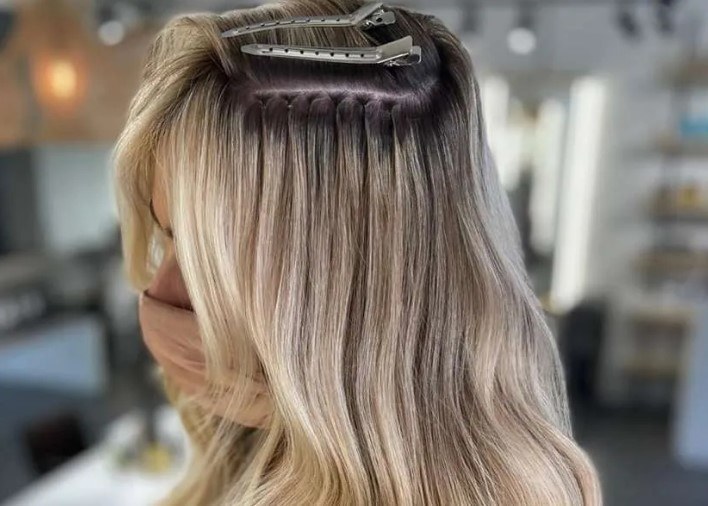
Micro-ring extensions use tiny metal rings clamped around a small section of natural hair alongside the extension strand. Nano-rings are simply a smaller version of the same principle, and they are generally preferred for fine and thin hair because the ring itself is smaller and lighter. No heat and no adhesive are involved, which means there is no chemical or thermal stress on the hair shaft during application.
This method requires a high level of technical skill. The rings must be positioned far enough from the scalp to avoid tension but close enough that the bond does not become visible as the hair grows. At Ivana Farisei, nano-ring application is performed with a precision tool that ensures consistent ring size and clamping pressure — an apparently small detail that makes a significant difference to long-term hair health. Move-up appointments are generally needed every eight to twelve weeks.
Keratin Bond Extensions: A Premium Option for the Right Candidate
Keratin bond (fusion) extensions use a small bead of keratin adhesive, melted with a heat tool, to bond the extension strand to a section of natural hair. The result is a natural-looking, highly durable bond that moves freely with the hair. However, this method is not universally suitable for fine hair. The bond, while small, does concentrate weight on a precise point, and on very fragile or low-density hair, this can create stress.
The suitability question is closely related to the condition of the natural hair. Clients who have had a keratin treatment to smooth their hair need to inform their stylist before booking fusion extensions, as the treatment alters the hair’s surface chemistry and can affect bond adhesion. Fine hair that is in good condition — properly moisturised, not chemically over-processed — can support keratin bonds beautifully when the stylist uses a lightweight, thin bond and works in appropriately small sections. Fine or fragile hair that is already compromised is better served by a lower-tension method first.
Clip-In Extensions: The Beginner-Friendly Approach
Clip-in extensions are the most accessible entry point for anyone curious about added volume or length. They require no professional application, cause no permanent attachment, and can be removed at the end of the day. For fine hair, the key is selecting a lightweight clip-in set — heavy clip-ins with large pressure clips can place painful and damaging traction on fine roots, especially when worn for extended periods.
Clip-ins are best used for occasions rather than daily wear. The cumulative friction of daily application and removal, particularly if done hastily, can thin the hair at the clip points over months. For special events — summer weddings from June through August, Christmas parties in December, or autumn photoshoots in October — clip-ins offer a wonderful temporary boost without any commitment.
Sewn-In Weft Extensions: For Fuller Fine Hair
Sewn-in weft extensions (sometimes called weaves) involve braiding the natural hair into cornrows and then sewing a weft of extension hair onto those braids. This method is generally better suited to medium or thick hair, as the braids themselves require a certain amount of natural hair. However, there is a modern variation — the “beaded weft” or “hand-tied weft” — that sits flat against the scalp without cornrows and uses micro-beads for attachment. This version is considerably more appropriate for fine hair and has become increasingly popular at salons like Ivana Farisei precisely because of its versatility.
Seasonal Considerations: When to Book Your Extensions
The time of year has a modest but real effect on extension performance. Summer heat and humidity (particularly July and August in the UK) can loosen tape adhesives more quickly and cause micro-ring bonds to slide on fine hair if the hair produces excess sweat at the scalp. Booking a tape-in application for late May or early June, before the hottest weeks, gives the bonds time to settle and allows the stylist to adjust the technique for the season.
Conversely, autumn and winter (October through February) tend to be kinder to bonds. Indoor heating can dry the hair, however, so a regular conditioning regimen is important year-round. Ivana Farisei provides clients with a seasonal aftercare guide at each appointment — a small but genuinely useful detail that distinguishes a thoughtful salon from a transactional one.
How to Choose the Right Method for Your Hair
The honest answer is that no single method is universally best for fine hair — the right choice depends on your hair’s density, condition, lifestyle, and budget. A thorough consultation at a reputable hair extension salon in london like Ivana Farisei will cover all of these factors before any decision is made. The team there will not push the most expensive method or the fastest application — they will recommend what your hair can actually sustain.
As a general guide: nano-rings and tape-ins are the safest starting points for most fine-haired clients. Keratin bonds are excellent for fine hair in good condition. Clip-ins are ideal for occasional use. Hand-tied weft methods suit clients who want more volume across the whole head. And in all cases, the skill of the stylist matters more than the method itself — because even the gentlest technique can cause damage in inexperienced hands.
Aftercare: The Factor Most People Underestimate
Whichever method you choose, aftercare is where the health of your natural hair is won or lost. Fine hair with extensions requires sulphate-free shampoo (sulphates accelerate bond breakdown), a lightweight conditioner applied mid-length to ends only, and gentle detangling from the ends upward. Sleeping with hair in a loose plait or on a silk pillowcase reduces friction significantly. Ivana Farisei stocks a curated range of extension-safe products and includes a personalised aftercare briefing with every installation — not a printed leaflet, but an actual conversation about your specific hair and lifestyle.
Fine hair with extensions is not fragile — it is simply specific. Treat it with the right method, the right stylist, and the right aftercare, and it will reward you with the volume and length you have always wanted.